David Drexlin

PhD student · TU Berlin & BIFOLD

Servus! I am a PhD student at TU Berlin and BIFOLD, supervised by Klaus-Robert Müller. Previously, I studied computer science at TU Berlin as an ELIZA scholarship holder. During my undergraduate studies, I worked at IBM on data science, software engineering, and consulting projects.

My research focuses on generative models—particularly diffusion models—and representation learning, with applications in computational histopathology. I am interested in what learned representations capture, how they can guide generation, and how to make generative models more controllable and scalable. One part of this work explores how synthetic data can help models generalize to new datasets and settings.

Beyond my current work, I am curious about learning and planning, biological systems, and how machine learning can help us understand the natural world.

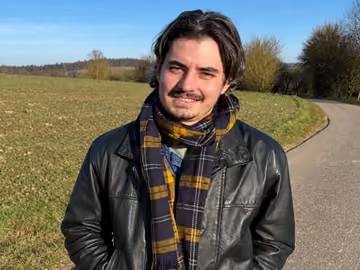
Portrait of David Drexlin standing outdoors on a country road wearing a scarf and leather jacket.

Get in touch

For research questions, collaborations, or speaking inquiries, reach me at drexlin@tu-berlin.de or through the profiles below.

Selected publications

Google Scholar
  1. Decoding Register Tokens Preserves Global Scene Details

    PreprintCurrently under review
    David Jacob Drexlin, Julius Hense, Jonas Dippel

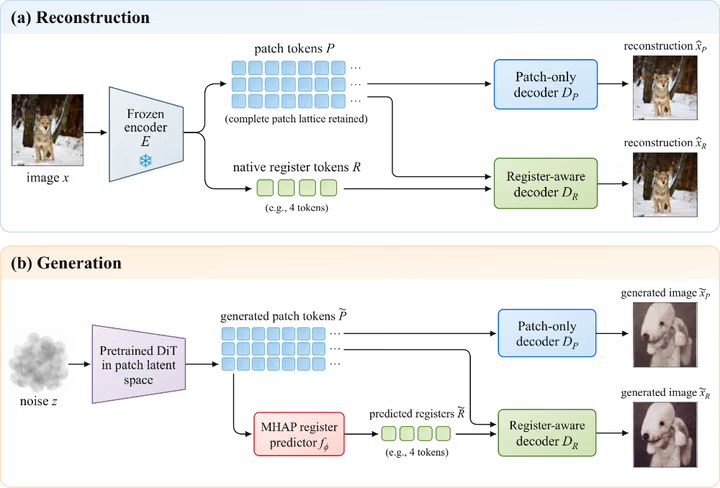
    Figure 1 from Decoding Register Tokens Preserves Global Scene Details showing register-aware decoding for reconstruction and generation.
    Figure 1. Decoding patches and registers for reconstruction and generation.

    We study what is lost when image decoders use only patch tokens. Retaining four register tokens alongside all spatial patches improves reconstruction from frozen DINOv2 and DINOv3 representations. For generation, a lightweight MHAP module recovers register features from sampled patches and improves image quality without retraining the diffusion model.

  2. MeDi: Metadata-Guided Diffusion Models for Mitigating Biases in Tumor Classification

    MICCAI 2025

    David Jacob Drexlin, Jonas Dippel, Julius Hense, Niklas Prenißl, Grégoire Montavon, Frederick Klauschen, Klaus-Robert Müller

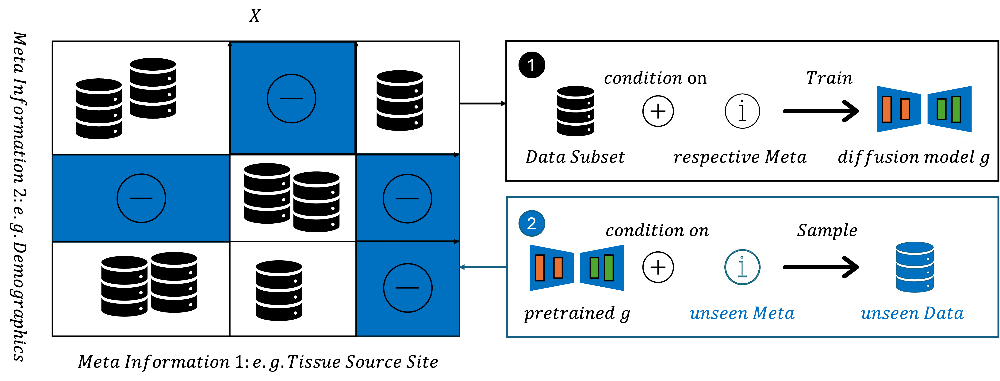
    Figure 1 from MeDi showing the training and inference framework for metadata-guided diffusion.
    Figure 1. MeDi training and inference framework for metadata-guided synthesis.

    MeDi uses metadata such as tissue source site and other patient or acquisition attributes to guide the generation of histopathology images for underrepresented subpopulations. We show that this targeted augmentation improves fidelity and can improve tumor classification under subpopulation shift, including for combinations not seen during training.